الوصف
First published in France in 1825, Brillat-Savarin's exuberant collection of dishes, experiences and philosophy reflected a new era in French cuisine - the advent of the restaurant, which gave the bourgeoisie the opportunity to select their dishes with precision and anticipation.
Jean Anthelme Brillat-Savarin was born in France in 1755 and died in 1826. Mary Frances Kennedy Fisher, author of The Art of Eating, was born in 1908 and died in 1992. Bill Buford, author of Heat, lives in New York City. From the Hardcover edition.
Jean Anthelme Brillat-Savarin(17551826) was a lawyer and the mayor of Belley, France, before he fled the Revolution in 1793. After a brief exile in the United States, he returned to Paris and was appointed a judge in the court of appeals. He spent the last twenty-five years of his life living peacefully in Paris and writing The Physiology of Taste. Mary Frances Kennedy Fisher(19081992), author of Consider the Oyster, How to Cook a Wolf,and more than twenty other books about the art of eating well, is widely acknowledged as a pioneer of food writing as a literary genre.
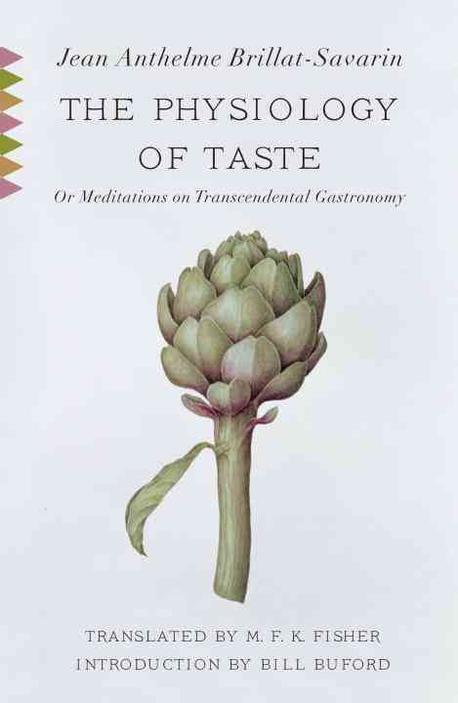
A culinary classic on the joys of the tablewritten by the gourmand who so famously stated, "Tell me what you eat, and I will tell you what you are"in a handsome new edition of M. F. K. Fisher's distinguished translation and with a new introduction by Bill Buford. First published in France in 1825 and continuously in print ever since, The Physiology of Taste is a historical, philosophical, and ultimately Epicurean collection of recipes, reflections, and anecdotes on everything and anything gastronomical. Brillat-Savarin, who spent his days eating through the famed food capital of Dijon, lent a shrewd, exuberant, and comically witty voice to culinary matters that still resonate today: the rise of the destination restaurant, diet and weight, digestion, and taste and sensibility. From the Hardcover edition.
A delightful and hilarious classic about the joys of the table, The Physiology of Taste is the most famous book about food ever written. First published in France in 1825 and continuously in print ever since, Jean Anthelme Brillat-Savarin?? masterpiece is a historical, philosophical, and epicurean collection of recipes, reflections, and anecdotes on everything and anything gastronomical. Brillat-Savarin-who famously stated ??ell me what you eat and I shall tell you what you are??shrewdly expounds upon culinary matters that still resonate today, from the rise of the destination restaurant to matters of diet and weight, and in M. F. K. Fisher, whose commentary is both brilliant and amusing, he has an editor with a sensitivity and wit to match his own.
A delightful and hilarious classic about the joys of the table, The Physiology of Tasteis the most famous book about food ever written. First published in France in 1825 and continuously in print ever since, Jean Anthelme Brillat-Savarin's masterpiece is a historical, philosophical, and epicurean collection of recipes, reflections, and anecdotes on everything and anything gastronomical. Brillat-Savarin-who famously stated "Tell me what you eat and I shall tell you what you are"-shrewdly expounds upon culinary matters that still resonate today, from the rise of the destination restaurant to matters of diet and weight, and in M. F. K. Fisher, whose commentary is both brilliant and amusing, he has an editor with a sensitivity and wit to match his own.
"It takes someone like Brillat-Savarin to remind us that cooking need not be the fraught, perfectionist, slightly paranoid struggle that it has latterly become. His love of food is bound up with a taste for human error and indulgence, and that is why The Physiology of Tasteis still the most civilized cookbook ever written." - The New Yorker "The Physiology of Taste is about the pleasures of the table-how to eat, when to eat, why to eat-but it is also about much, much more. Along the way, Brillat-Savarin philosophizes, gossips, and recalls past flirtations. . . . High spirited and irreverent, Fisher matches his philosophical meanderings. Her extensive translator's notes, which take up almost a quarter of the book, are funny and scholarly by turns." - San Francisco Chronicle
??t takes someone like Brillat-Savarin to remind us that cooking need not be the fraught, perfectionist, slightly paranoid struggle that it has latterly become. His love of food is bound up with a taste for human error and indulgence, and that is why The Physiology of Taste is still the most civilized cookbook ever written.??- The New Yorker "The Physiology of Taste is about the pleasures of the table-how to eat, when to eat, why to eat-but it is also about much, much more. Along the way, Brillat-Savarin philosophizes, gossips, and recalls past flirtations. . . . High spirited and irreverent, Fisher matches his philosophical meanderings. Her extensive translator's notes, which take up almost a quarter of the book, are funny and scholarly by turns." - San Francisco Chronicle
"Still the most civilized cookbook ever written." The New Yorker From the Hardcover edition.